


In this essay I’m exploring the use of AI coding agents as a contemporary form of cognitive augmentation among developers. Drawing on the distinction between systemic and personal perspectives on cognitive artefacts, I’ll argue that although the hybrid developer–AI system may increase execution speed and economic performance, these benefits do not automatically entail cognitive enhancement for the individual user. To investigate this tension, I’ve conducted a survey (89 respondents) and the findings indicate significant extrinsic benefits while also highlighting relevant intrinsic costs, including mental exhaustion, occupational stress, and a reduced capacity to recover after working hours. I’m proposing that, when developers are empowered to retain control over their collaboration with AI coding agents, and thus stay in a position to comprehend and actively guide the final output of the hybrid developer–AI cognitive system, this mode of operation can become a sustainable form of cognitive support.
Introduction
A study conducted in 2025, involving more than 48,000 people from 47 countries, shows that AI has already become an important part of everyday work, with 3 in 5 employees intentionally and regularly using AI to carry out their tasks, and nearly one third using it weekly or more often (Gillespie et al., 2025). Adding to this, the Anthropic report published in March 2026 places computer developers first among the occupations analyzed, with approximately 75% observed exposure to AI use (Massenkoff & McCrory, 2026). Then, in a recent interview, Marc Andreessen, co-founder and general partner at Andreessen Horowitz, co-creator of the Mosaic web browser and co-founder of Netscape, as well as author of “The Techno-Optimist Manifesto” (Andreessen, 2023), explained the term used in Silicon Valley to describe the new reality of developers who use AI coding agents - “AI Vampires”:
“You stay up all night coding with AI, because you are so productive, you are getting so many things done, that you cannot stop. The opportunity cost of sleep becomes too high, because if you go to bed, you will no longer be there with the 20 AI coding agents, keeping them moving across all the projects you have put them to work on. Compared with six months ago, these developers look terrible: they are sleep-deprived, they have dark circles under their eyes. It is very clear that they are no longer taking care of themselves. And, at the same time, they are absolutely ecstatic, because they can produce 5, 10, 20 times more code than before.” (Rogan, 2026)
Such anecdotes suggest that the benefits developers obtain in terms of execution speed and volume come at a high price (no, not talking about token costs here): an intensification of the cognitive effort required to maintain control over AI coding agents, the possible degradation of the quality of cognitive processes and, ultimately, harm to the individual’s quality of life.
In this context, the human–AI partnership raises profound dilemmas concerning the long-term sustainability of the quality of human cognitive processes and psychological balance (Rice, 2026). I’m proposing a critical examination of the claim that the use of AI coding agents automatically leads to cognitive enhancement and, in doing so, I adopt as a foundational premise the desideratum that “users must be empowered, their autonomy respected, and their decision-making capacities strengthened, for technology to be considered a genuine enhancement” (Voinea et al., 2020).
In support of the analysis, I’ve also conducted a study to measure developers’ perceptions of the impact that AI coding agents have on them; the raw (anonymised) answers can be accessed publicly at (in case anyone wants to do a further analysis): https://github.com/cborodescu/ai-vampires and a more friendly exploration of the insights can be found here: https://cborodescu.github.io/ai-vampires/.
Cognitive Augmentation Using AI Coding Agents
When we speak of cognitive enhancement, the primary aim is to increase the speed or capacity of information processing among normal, healthy individuals. This allows the acquisition of information (perception), its selection (attention), representation (understanding), retention (memory), and the use of information to guide behaviour (Heersmink, 2015, citing Bostrom & Sandberg, 2009) to be carried out more quickly and with fewer errors. It may also make possible tasks that would otherwise be beyond the capabilities of the human brain.
It cannot be argued that the augmentation of human cognition is a new phenomenon or that we began to consider the issue in such terms with the emergence of artificial intelligence. Given the multidimensionality of human cognition, there are numerous methods, technologies, and strategies through which it can be augmented (Heersmink, 2017). In fact, the development of written language triggered the emergence of some of the most sophisticated “cognitive artifacts” (Heersmink, 2017), which today we no longer even think about in such terms, although they are almost indispensable in everyday life: the notebook in which we take various notes, or even maps, whether in physical or digital format and, of course, the mobile device that is so indispensable to modern human beings.
Throughout human evolution, the mind has undergone a continuous process of extension through these artifacts, and the use of the AI coding agent is merely the latest in a long series of media that will probably continue to develop with the aim of augmenting the capacities of biological brains to store and process the information that reaches us in ever-increasing quantities. One of the reasons why certain philosophers and researchers in cognitive science argue that we are, at least metaphorically or conceptually speaking, “natural-born cyborgs” (Clark, 2003, cited in Danaher, 2019; Case, 2010, cited in Danaher, 2019), lies in the view that when the human organism is connected to an external entity (in our case, the AI coding agent) in a bidirectional interaction, a coupled system is created that can be regarded as a cognitive system in itself (Clark & Chalmers, 1998). Within this system, both biological (internal) and external resources play an active causal role, jointly governing behavior. This is Clark and Chalmers’s (1998) “active externalism,” which emphasizes external elements present “in the loop” that have a direct impact on the subject’s behavior in the present: if we keep the internal structure (the brain) constant but change the elements of the external supporting environment, the person’s behavior may change completely.
Clark’s notion of dynamism is evident in our interactions with other people, to whom we often offload cognitive tasks; for example when we ask our partner, yet again, to recall the name of the restaurant we visited during a holiday in Capri. The same occurs in developers’ interactions with AI coding agents, giving rise to a system within which cognitive augmentation takes place. However, it is time to qualify the umbrella term “cognitive augmentation” by drawing on the distinction introduced by Norman (1991), namely: the “personal view” and the “system view” of cognitive artifacts.
Although at first glance AI coding agents appear to enhance cognition by making task execution more efficient, what actually occurs is a transformation of one cognitive task into another. Norman (1991) uses pilots’ use of checklists as an example: although the error rate decreases, the process shifts from biological memory to external processing.
From a system perspective, we can define the human–AI ensemble as an augmented cognitive system because it is more reliable; however, from the developer’s personal perspective, we are witnessing only a reconfiguration of effort, not an elevation of intrinsic biological capacity. Thus, augmentation becomes visible only when we view the entire system from the outside, while technology’s mediating function within decision-making processes becomes clear. If we follow the personal perspective of the developer who uses an AI coding agent, the question is to what extent this hybrid cognitive system (developer–AI) represents an intrinsically good form of augmentation?
Before analyzing the results of the questionnaire, we can briefly consider the unintended consequences that a navigation system such as Google Maps or Waze may have on a driver’s ability to orient themselves when they do not have access to their mobile device. Certainly, a new ability is developed (that of integrating the functionality of these devices into navigation practices) at the cost of the accuracy and level of detail of internal cognitive maps (Burnett and Lee, 2005). And so, if we accept that there may be unintended consequences for our internal cognitive capacities when we use these artifacts, we may ask what kind of cost developers pay, with or without their informed consent, when they use such AI coding agents and biological knowledge suffers?
Analysis of the Questionnaire Results
To evaluate how AI coding agents affect the developer community, a 15-item questionnaire was circulated across various channels, including LinkedIn, Reddit, and WhatsApp. It should be noted that the term developer as used in this study is not a strict one, limited by formal training in information systems engineering. A person may have a formal education in philology but may be considered a developer as long as they have the ability (whether or not augmented through AI coding agents) to develop computer programs/applications.
89 respondents participated in this study, with 68.5% identifying their current role as Engineering and 76.4% having at least six years of experience in the field in which they work (not limited to technical fields). The dimensions of interest covered by the questionnaire can be divided into two categories (see the table below), and the questions corresponding to each dimension used a five-point Likert scale, with scores ranging from 1 (strongly disagree) to 5 (strongly agree).
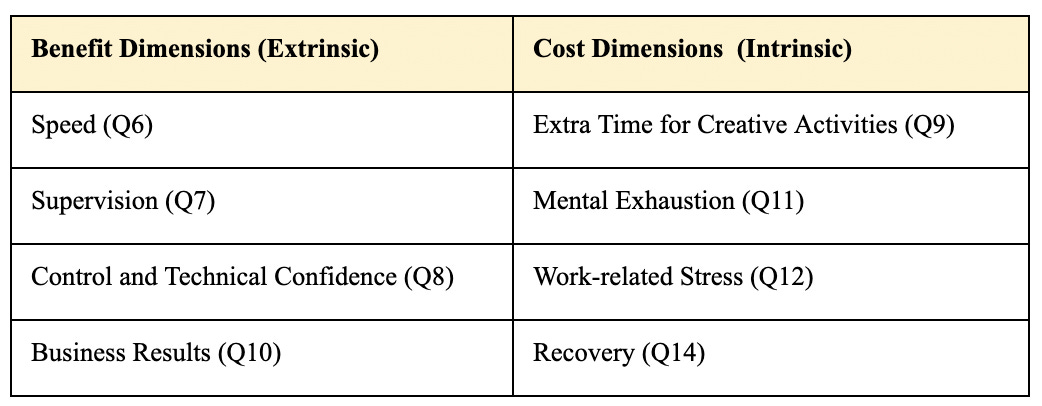
The balance of the benefit and cost dimensions for which statistically significant Likert scores were obtained (n = 89, p-value < 0.05) reveals several interesting aspects:
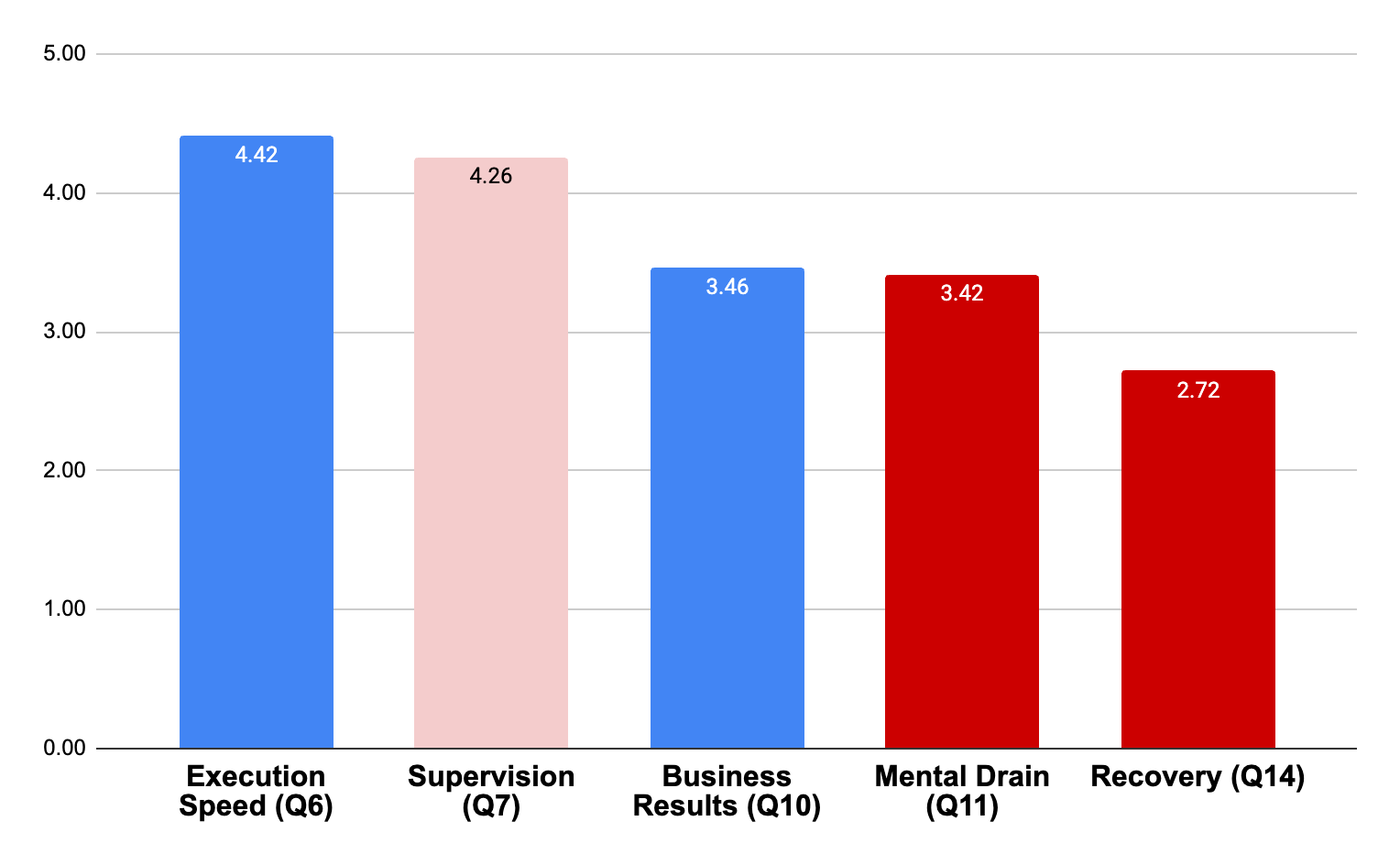
Strong agreement regarding increased execution speed (mean Likert score = 4.42) and more moderate agreement concerning the achievement of economic outcomes (mean Likert score = 3.46) as a result of using AI coding agents;
Respondents reported elevated mental exhaustion (mean Likert score = 3.42) and reduced capacity to disconnect and recover after work (mean Likert score = 2.72) as a result of using AI coding agents;
Although classified initially as a benefit dimension, the effort invested in supervising and verifying the code generated by AI coding agents (mean Likert score = 4.26) was at a high level, which would indicate a cost instead.
The generalized economic impact myth associated with AI adoption, specifically the use of AI coding agents and its presumed contribution to business growth seem to be challenged by the respondents of this study, as 50% of them did not agree with the claim that this way of working had contributed to measurable economic outcomes, such as customer growth, increased revenue, or improved retention.
Perhaps connected with this myth, the data surfaces an almost 20% gap between the economic value perceived by respondents who identified as having an engineering role and that reported by those with a non-engineering profile (entrepreneurs, founders, product, sales/marketing, etc.) following the use of an AI coding agent. Notably, individuals in non-engineering roles used AI coding agents for about 1.63 hours more per day (a 36% increase) than their engineering counterparts and reported 10% higher gains in execution speed.
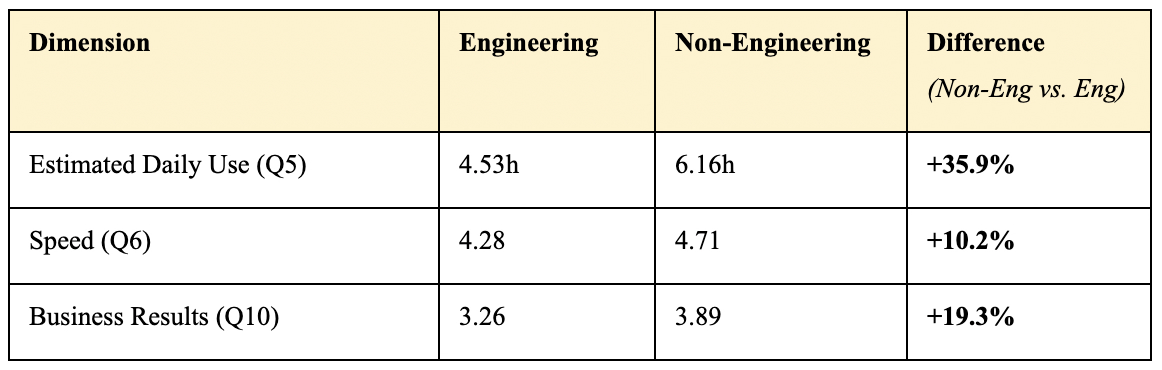
These differences do not establish that non-engineering users objectively derive more value from AI coding agents. First, the outcomes are self-reported and may reflect differences in expectations, attribution, or enthusiasm toward AI-assisted work. Second, occupational context may affect how gains become visible: entrepreneurs/founders can often translate increased output directly into product launches, customer acquisition, or revenue, whereas engineers working in larger organizations may contribute only indirectly to such outcomes. The observed differences may therefore reflect both genuine differences in value capture and differences in how that value is perceived and reported, since the questionnaire didn’t actually ask for an objective dollar value. These findings may partly reflect selection biases (from both profiles) and should be interpreted as exploratory rather than as evidence of an inherent advantage for non-engineering profiles.
Shifting our focus to the dimension of Control and Technical Confidence (Q8), its central importance becomes clear. Although it is conceptually regarded as a benefit since developers ought to experience greater agency over the results and trust in the technical path of their projects, the empirical evidence fails to validate this assumption. Instead it shows a neutral average score (Likert = 3.00). To explore the friction between the benefits and costs of using AI coding agents, we will analyze the Control and Technical Confidence (Q8) factor in relation to other key dimensions, uncovering the fundamental correlations at play.
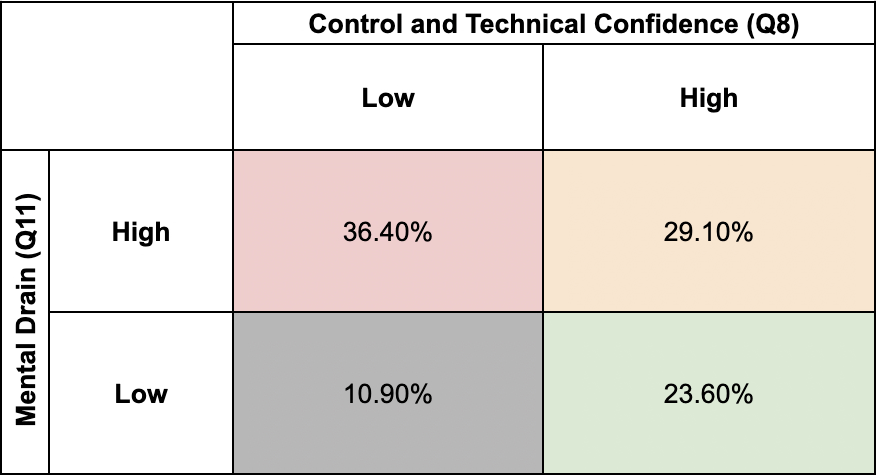
The first quadrant I propose for analysis is defined by the dimensions Control and Technical Confidence (Q8) and Mental Exhaustion (Q11). We can immediately observe a high percentage (~36%) of non-neutral respondents who report a low level of control and technical confidence in the work resulting from collaboration with AI coding agents, combined with a high level of cognitive exhaustion. This segment also reports perceived business outcomes close to the neutral point (mean Likert score = 2.80). Rather than indicating that exhaustion necessarily originates outside the dynamics of AI use, this pattern may describe an inefficient or unsustainable form of collaboration in which users experience high information-management demands without obtaining corresponding business benefits.
The correlations go even further: unfavorable scores are also recorded for the dimensions Professional Satisfaction & Engagement (Q13, mean Likert = 2.35), Extra Time for Creative Activities (Q9, mean Likert = 2.15), and Work-related Stress (Q12, mean Likert = 3.90) among those affected by mental exhaustion and a lack of control and technical confidence in the final output and direction of their work with AI coding agents.
We then have two respondent segments which, although they share a high level of control and technical confidence in the output of their collaboration with AI coding agents, diverge in terms of cognitive exhaustion: ~24% - High Control and Technical Confidence (Q8) & Low Mental Exhaustion (Q11); ~29% - High Control and Technical Confidence (Q8) & High Mental Exhaustion (Q11). It should be noted that both user segments report high levels of both Supervision (Q7) of AI coding agents (mean Likert scores: 4.23 and 4.69, respectively) and business outcomes (mean Likert scores: 4.00 and 4.44, respectively).
We can therefore formulate a first observation regarding the performance of the human–AI cognitive system in using AI coding agents: high control and technical confidence, together with high reported execution-speed gains and perceived business outcomes, do not necessarily imply cognitive enhancement of the human subject. This is demonstrated by the coexistence of these benefits with high mental exhaustion in one of the identified respondent segments.
By contrast, the segment defined by High Control and Technical Confidence (Q8) and Low Mental Exhaustion (Q11) may be interpreted as a comparatively sustainable-use profile. Most respondents in this segment have between 6 and 15 years of professional experience and use AI coding agents for up to 6 hours per day, while their organizational contexts may vary. They report high execution-speed gains (mean Likert score = 4.77), strong perceived business outcomes (4.00), high satisfaction and engagement (4.38), and improved recovery (3.62), together with low work-related stress (1.54). These results suggest that respondents in this segment obtain benefits from working with AI coding agents while retaining technical control and without reporting elevated mental exhaustion.
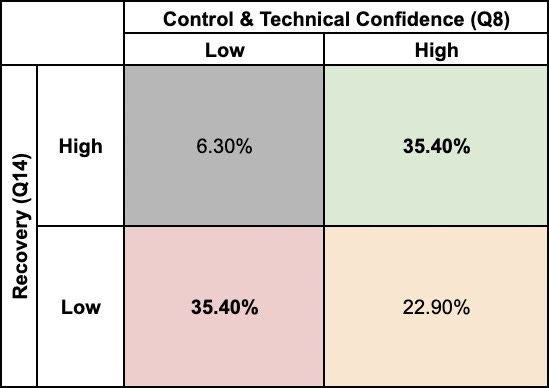
Turning now to the quadrant defined by Control and Technical Confidence (Q8) and Recovery (Q14), we identify two equally large opposing profiles among respondents with non-neutral scores on both dimensions. Approximately 35% report both high control and high recovery, while another 35% report both low control and low recovery. The high-control/high-recovery group may be described as a functional recovery profile: its members use AI coding agents for an estimated average of approximately five hours per day and nevertheless report that they are able to disconnect and recover after work. Their professional experience, working time, and organizational contexts are varied.
Therefore, if we consider the two quadrants together, we can argue that confidence in the technical quality of the outputs provided by the AI coding agent, coupled with the developer’s ability to exercise control (agency) over the final outcome, can foster both reduced mental exhaustion for ~24% of participants and improved recovery capacity for ~35% of respondents. Thus, this study confirms the perspective advanced by Voinea et al. (2020), according to which “users must be empowered, their autonomy respected, and their decision-making capacities strengthened, for technology to be considered a genuine enhancement.”
But what about the approximately 65% of respondents who report high levels of mental drain, or the roughly 63% who experience difficulties recovering after work, regardless of their confidence in the technical quality of the AI coding agent’s outputs or their perceived level of control? The hope, if it can be called that, is that they are among those who report positive economic outcomes; outcomes so positive that, following careful personal reflection, they may compensate for the intrinsic costs these respondents have incurred or continue to incur, insofar as they remain willing to bear them.
Yet this points to another myth, also suggested by Marc Andreessen in the excerpt included in the introduction (and widely promoted by many startup investors): achieving positive economic outcomes requires developers to accept, or even embrace, mental exhaustion and an inability to recover after work: the “AI Vampires.” According to this view, personal sacrifice is the absolute condition for fully exploiting the speed and efficiency provided by AI agents.
Among respondents who report high control and technical confidence, those who also report high mental exhaustion have a higher mean score for perceived business results than those with low mental exhaustion (4.44 compared with 4.00, ~ 11%). A nearly identical difference is observed when comparing respondents with high and low recovery: those combining high control with high recovery report a mean business results score of 4.35, compared with 3.91 among those combining high control with low recovery, again a difference of approximately 11%. Neither subgroup difference is statistically significant, however. The results should therefore not be interpreted as evidence that either mental exhaustion or improved recovery produces stronger business outcomes. Rather, they indicate that high perceived business value can coexist with both cognitive exhaustion and functional recovery, suggesting that similar economic benefits may be achieved through substantially different human experiences of AI-assisted work; so much for “struggle porn”, right?
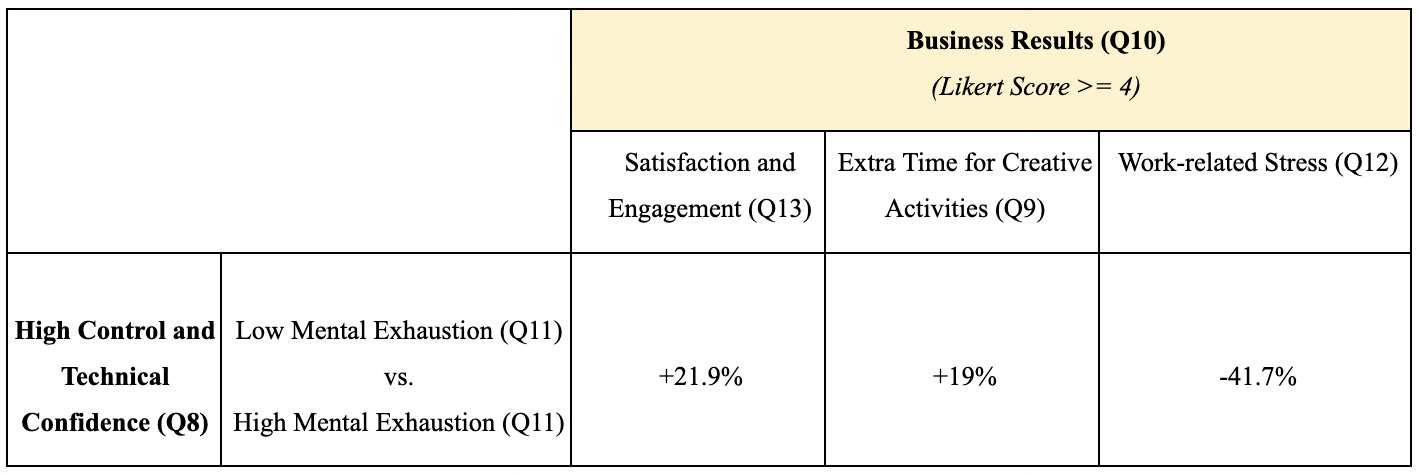
Moreover, respondents who combine High Control and Technical Confidence with Low Mental Exhaustion report strong perceived Business Results (Q10, mean Likert score = 4.00), high Satisfaction and Engagement (Q13, mean = 4.38), more time for enjoyable, meaningful, or creative activities (Q9, mean = 4.00), and low Work-related Stress (Q12, mean = 1.54). The findings suggest that strong performance does not necessarily require accepting cognitive degradation because the more sustainable profiles appear to combine the benefits with technical control, meaningful engagement, lower stress, and the capacity to recover after work. Ultimately, the sustainability of cognitive augmentation raises a normative dilemma: what degree of cognitive strain, reduced recovery, or loss of autonomy are individuals willing to accept in exchange for greater execution speed and economic benefit, and under what conditions can such a trade-off be considered genuinely voluntary and ethically acceptable?
Limitations and Directions for Future Research
Several limitations should be considered when interpreting the results of this study. First, the sample is relatively small and respondents were recruited through channels such as LinkedIn, Reddit, and WhatsApp, which may have attracted participants with stronger opinions, greater familiarity with AI coding agents, or unusually intensive usage patterns. The sample is also weighted toward experienced professionals and frequent users, limiting the extent to which the findings can be generalized to the broader population of developers or to occasional and inexperienced users.
Second, the study relies on cross-sectional, self-reported perceptions so we cannot determine whether AI-agent use produced the reported mental drain or recovery difficulties, whether already overworked individuals adopted these tools more intensively, or whether both outcomes are shaped by wider organizational, professional, and personal conditions. Similarly, the reported gains in execution speed and business outcomes were not independently verified through objective measures.
Future research should make it possible to distinguish more reliably between roles, experience levels, organizational culture and usage intensities.
A Case For Individual Responsibility
We have shown that AI coding agents used to generate code, when employed within a hybrid cognitive system (human–AI), can have divergent effects on mental exhaustion, recovery capacity, professional dedication and fulfilment, or workplace stress. And so, who is responsible, and to what extent, when intrinsic costs become too high?
According to Constantinescu et al. (2022), it is difficult to attribute this moral responsibility to the AI coding agent from an Aristotelian perspective as long as the following four conditions are not met: (1) the causation condition - to produce an outcome through their own initiated and controlled (in)action; (2) the freedom condition - to act physically and psychologically uncoerced, according to their own will and intention; (3) the knowledge condition - to know the relevant details concerning the context of the (in)action; (4) the deliberation condition - to possess the capacity to morally evaluate the significance of their action and inaction in relation to a purpose.
Perhaps responsibility falls on the shoulders of the companies that develop such AI coding agents? After all, they control an essential component of our cognitive system and therefore, to some extent, also the actions that arise from this hybrid collaboration. Such a conclusion, at least an interim one, would be plausible if we consider that technological artifacts “have politics” in the sense that they result from a complex and value-oriented decision-making process, one that generates both benefits and moral residues (Popa et al., 2023).
On the other hand, we are at a stage in which such hybrid cognitive systems (human–AI) are prevalent, especially in technology companies. More and more employers recognize and reward people who deliver efficiency by augmenting their own capacities because the benefits they bring to the company in terms of productivity (execution speed and economic outcomes) are undeniable in many cases (as we saw in the study itself). This perspective nevertheless entails a major risk at the individual level: the erosion of professional autonomy. In this context, developers may experience systemic pressure to adopt specific augmentation strategies, even when these conflict with their own way of working or their will.
Should employers, then, be held responsible for the individual costs borne by employees whose cognitive capacities are augmented through AI coding agents - tools that are, in most cases, provided by the companies themselves? At the same time, it may be argued that skills acquired through individual intellectual effort possess greater value than those made readily available through an AI conversational interface, particularly when no direct and critical review of the code takes place. Cognitive abilities acquired exclusively through AI augmentation may therefore become devalued, rendering them less admirable or authentic (Heersmink, 2015, citing Bostrom & Sandberg, 2009).
When short-term thinking and access to shortcuts become the determining factor in success or failure, virtues such as perseverance and the willingness to work hard toward one’s own goals risk becoming unattractive. Liu et al. (2026) reached this conclusion in research published in April 2026, showing that just 10–15 minutes of interaction with AI can lead to significant impairments in independent performance and perseverance, capacities fundamental to lifelong learning. The cumulative effects of daily AI use over months or years may be profound and difficult to reverse, analogous to the “boiled frog” effect, in which each incremental act appears costless until the cumulative effect becomes overwhelming to manage (Moore et al., 2019, cited in Liu et al., 2026; Kasirzadeh, 2025, cited in Liu et al., 2026).
This is also supported by the Theory of Augmented Cognitive Extension (Peine & Abhari, 2026), which argues that sustained interactions with an AI coding agent can transform the system into a quasi-internal component of the developer’s cognitive ecology. This integration is governed by five interrelated mechanisms—attentional synchronization, epistemic calibration, affective attunement, risk perception, and narrative stabilization, which determine whether AI strengthens or destabilizes the process of meaning-making.
Following an initial phase of adaptation, users enter a period in which verification practices are negotiated. Over time, these micro-adjustments may lead either to overdependence through the routinized externalization of cognitive tasks or to a form of reflective integration grounded in meta-awareness, which preserves the developer’s agency and intentional authorship.
This dynamic can also be explained through the distinction proposed by Sweller in “Cognitive Load Theory” (2011), according to which knowledge may be divided into biologically primary and biologically secondary forms. While listening and speaking are examples of biologically primary knowledge, reading and writing constitute corresponding examples of biologically secondary knowledge. Most of us acquire the ability to listen and speak naturally, simply by participating in a society structured around these activities. For millennia, however, access to reading and writing remained restricted to elites in certain cultures, while the broader population did not acquire these abilities in the absence of formal instruction.
This distinction is rooted in our biology: human beings are evolutionarily adapted for oral communication but have not evolved specifically to decode written text. The discrepancy between innate and acquired communication systems therefore has major cognitive and educational implications. When the objective is to facilitate genuine cognitive enhancement, fostering individual responsibility, preserving autonomy, and strengthening biologically grounded decision-making mechanisms become integral components of the acquisition of biologically secondary knowledge.
Thus, responsibility manifested at the individual level could translate into using these AI coding agents to better understand the context of their actions and the possible implications of the task to be performed. In such an approach, augmentation goes beyond the simple delegation of execution to the AI coding agent, while responsibility remains anchored in the human agent.
Conclusions
In this essay, I analyzed the use of AI coding agents as a form of cognitive augmentation, starting from the tension between the promise of productivity & economic results and the intrinsic vulnerabilities it may induce in the human user. On the one hand, the results of the exploratory study show that respondents confirm the extrinsic benefits of using AI coding agents (increased execution speed and contribution to superior business outcomes). On the other hand, the same results indicate the existence of human costs: mental exhaustion, difficulties with recovery, increased supervision effort, and an unclear relationship between this type of cognitive augmentation and professional fulfilment.
We can situate the thesis of this essay within a broader historical pattern already visible in the evolution of social media. Initially celebrated as an innovation that would democratize communication, strengthen communities, and expand individual agency, social media was evaluated primarily through its immediate systemic benefits: greater connectivity, faster information exchange, and unprecedented access to public participation. Only later did its less visible costs become apparent, including compulsive use, fragmented attention, polarization, surveillance, and declining psychological well-being. AI coding agents may follow a similar trajectory. The impact of employing AI coding agents cannot be measured merely by highlighting gains in productivity or commercial success while ignoring the potential threats to human cognitive integrity, individual independence, or overall health.
As the study showed, the pivotal dimension appears to be Control and Technical Confidence (Q8), because the difference between augmentation and degradation is determined by how the AI coding agent is integrated into the developer’s cognitive ecology: as a tool for clarification, reflection, and expansion of decision-making capacity, or merely as a mechanism for maximizing extrinsic benefits.
In this sense, the “AI vampire” model is incompatible with developers’ well-being in terms of autonomy, cognitive health, or professional dignity. The sustainability of cognitive augmentation lies in designing and using these AI coding agents so that they amplify human judgment, because authentic augmentation, understood as a process of self-creation or self-discovery, cannot be measured solely by what the human produces together with AI, but also by what remains with the human when we remove the AI coding agent from the equation.
References
AI Coding Agents Survey. (2026). [Google Forms]. Google. https://forms.gle/Tok7Kw8ZGK7bgedt5
Andreessen, M. (2023, October 16). The techno-optimist manifesto. Andreessen Horowitz. https://a16z.com/the-techno-optimist-manifesto/
Burnett, G. E., & Lee, K. (2005). The effect of vehicle navigation systems on the formation of cognitive maps. In G. Underwood (Ed.), Traffic and transport psychology: Theory and application (pp. 407–418). Elsevier.
Clark, A., & Chalmers, D. J. (1998). The extended mind. Analysis, 58(1), 7–19. https://doi.org/10.1093/analys/58.1.7
Constantinescu, M., Vică, C., Uszkai, R., & Voinea, C. (2022). Blame it on the AI? On the moral responsibility of artificial moral advisors. Philosophy & Technology, 35, Article 35. https://doi.org/10.1007/s13347-022-00529-z
Danaher, J. (2019). Automation and utopia: Human flourishing in a world without work. Harvard University Press.
Gillespie, N., Lockey, S., Ward, T., Macdade, A., & Hassed, G. (2025). Trust, attitudes and use of artificial intelligence: A global study 2025. The University of Melbourne and KPMG. DOI 10.26188/28822919
Heersmink, R. (2017). Extended mind and cognitive enhancement: Moral aspects of cognitive artifacts. Phenomenology and the Cognitive Sciences, 16(1), 17–32. https://doi.org/10.1007/s11097-015-9448-5
Liu, G., Christian, B., Dumbalska, T., Bakker, M. A., & Dubey, R. (2026). AI assistance reduces persistence and hurts independent performance. arXiv. https://doi.org/10.48550/arXiv.2604.04721
Massenkoff, M., & McCrory, P. (2026). Labor market impacts of AI: A new measure and early evidence. Anthropic. https://cdn.sanity.io/files/4zrzovbb/website/2b5bbaf2c1eb81dbf6e6fb813c1a24e35a64d376.pdf
Norman, D. A. (1991). Cognitive artifacts. In J. M. Carroll (Ed.), Designing interaction: Psychology at the human-computer interface (pp. 17–38). Cambridge University Press.
Popa, E. O., Blok, V., Katsoukis, G., & Schubert, C. (2023). Moral impact of technologies from a pluralist perspective: Artificial photosynthesis as a case in point. Technology in Society, 75, Article 102357. https://doi.org/10.1016/j.techsoc.2023.102357
Rice, D. (2026, May 15). There’s a name for what’s happening to your employees’ judgment. People Managing People. https://peoplemanagingpeople.com/workforce-management/ai-brain-fry/
Rogan, J. (Host). (2026, May 19). Joe Rogan Experience #2501 - Marc Andreessen [Video]. YouTube.
Voinea, C., Vică, C., Mihailov, E., & Savulescu, J. (2020). The internet as cognitive enhancement. Science and Engineering Ethics, 26, 2345–2362. https://doi.org/10.1007/s11948-020-00210-8